Tuesday, December 02, 2014

Has Ford gone too far with the engine downsizing in the Brazilian versions of the SuperDuty?

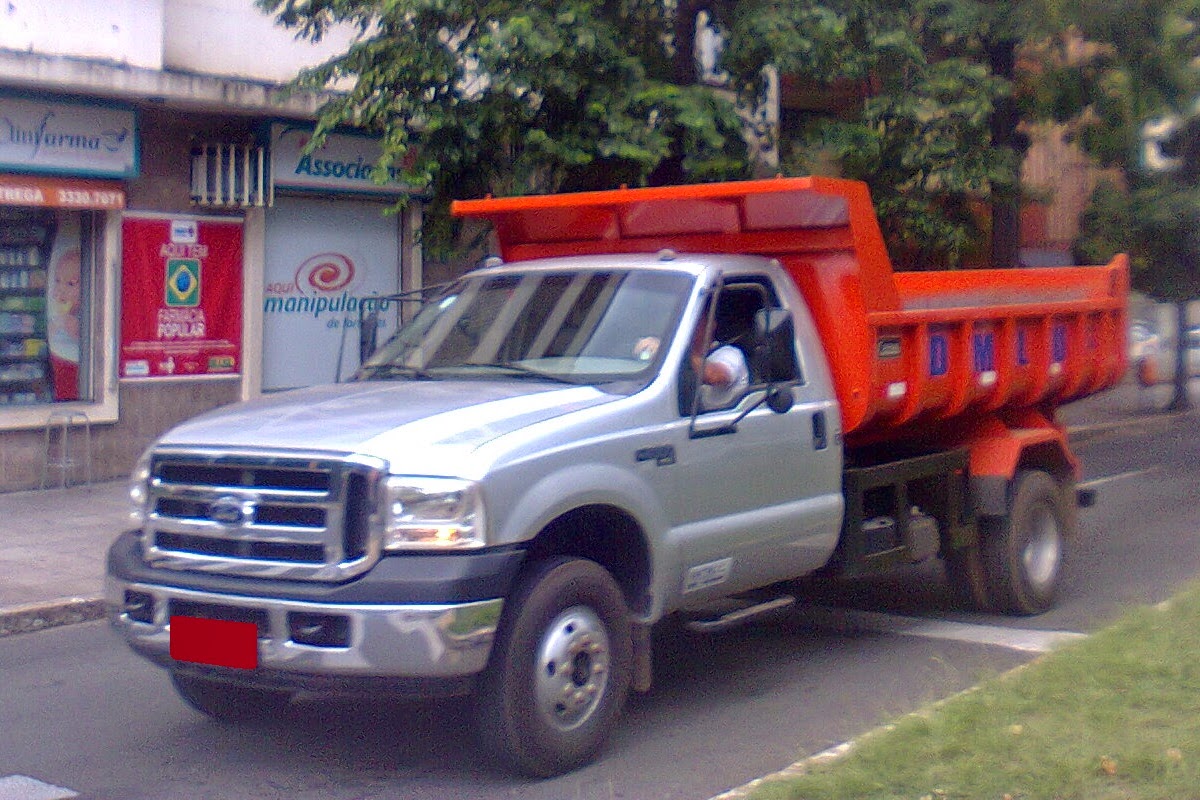
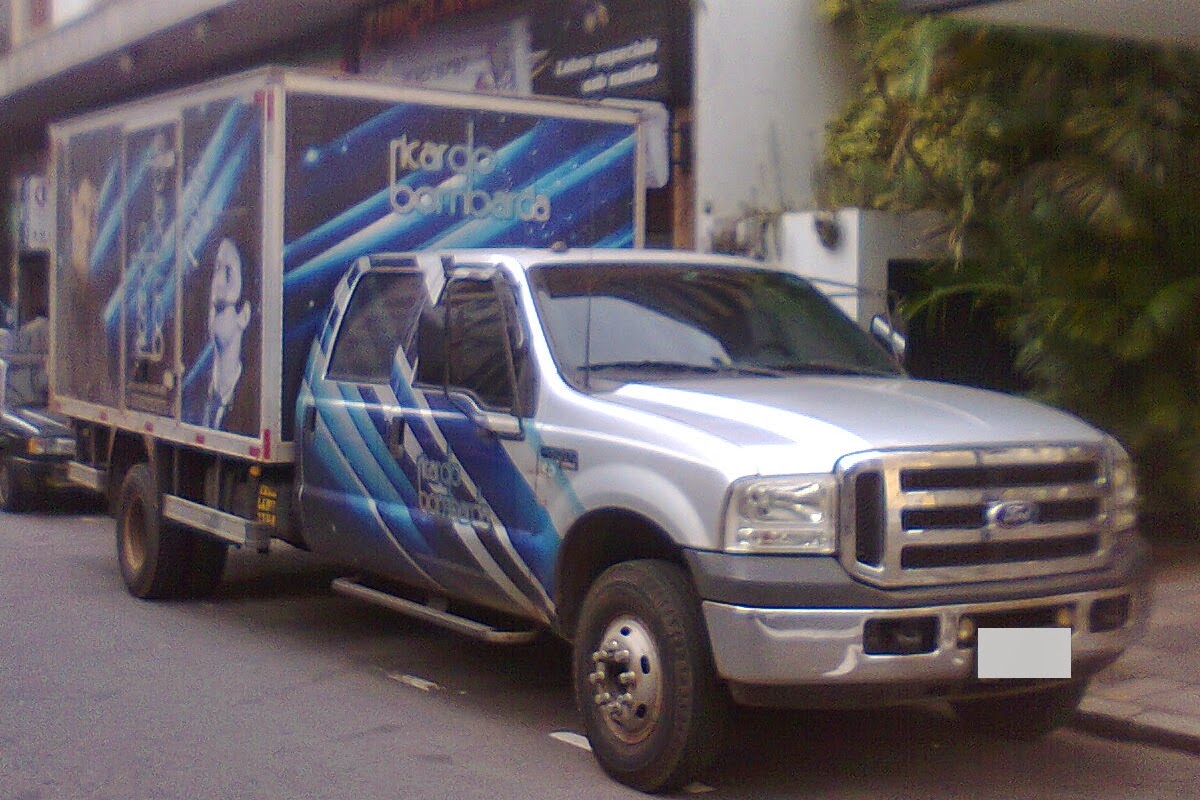
It ain't breaking news that Ford always used Diesel engines smaller than its American counterparts in the Brazilian F-Series, and lately in the SuperDuty, but it was a shock for many people when it was announced that starting in 2014 the F-350 (picture above, notice the saddle-mounted DEF tank with its blue filling cap) and the F-4000 (a local derivative of the F-450, shown in the picture below with crew-cab and a box-van body) would feature a Cummins ISF2.8 at their engine bay. The current Brazilian version of the F-350, available only in 2WD, is exclusive for the local market, while the F-4000 can be had in either 2WD or 4WD and is also exported to Argentina.

Actually, the F-4000 (the yellow one above might be from the 70's due to the white cabin roof, but got updated with a front clip from the 80's) has been fitted exclusively with a 4-cylinder Diesel since the 70's, and the F-1000 (a derivative of the OBS F-250 with the short bed of the F-150) had a high-speed turbodiesel with a displacement below 3-litre available between '97 and '98 for its 2WD variant, but the F-350 and F-4000 were never factory-fitted with any engine under 3.9-litre such as the Cummins B3.9 (also often referred to as "4BT") which became the sole powerplant for both the F-350 and F-4000 from late '98 to late 2011 when they were phased out because somebody at Ford South American Operations (FSAO) deemed it wouldn't be cost-effective to upgrade them with an electronically-governed engine compliant to Euro-5 emission standards, and trying to push the traditional buyers of the Brazilian F-Series/SuperDuty to the Ford Transit semi-bonnetted vans and the Ford Cargo forward-control truck sounded more profitable. But it was proved wrong and, after losing some market share for Volkswagen, Iveco and even to Hyundai and a few Chinese manufacturers, Ford had to reintroduce the F-350 and F-4000 (pictured below is a '05-'11 F-4000, with a mechanically-governed B3.9 detuned to 120hp in order to get compliant to the Euro-3 emission standards).
In spite of the controversies regarding the new engine, the SuperDuty already recovered its sales performance right after its reintroduction. In a contrast to the American market, where conventional bonnetted trucks remain the most popular configuration, nowadays forward-control trucks are prevalent in Brazil, so the cabin is the strongest sales argument for the F-350 and the F-4000 against its closest competition in the public utility and rural segments. The basic concept of the SuperDuty, less specialized than the current generation of Class 3 and Class 4 cab-forward trucks which are more focused on urban delivery, makes it more favorable for a wide range of operations not just in city and highway but also in rougher terrain.
While it could be deemed kinda obvious to just fit the same engine and transmission from the smaller versions of the Ford Cargo into the F-350 and F-4000 (pictured above is a '98-'05 Euro-2 F-4000 with a Cummins B3.9 rated at 141hp and an aftermarket supplementary cabin), a different engine was chosen, still supplied from Cummins, but for everyone's surprise it was the ISF2.8 instead of the ISBe4.5 currently used in some versions of the Ford Cargo ranging from Class 5 to 7, with its lower cost pointed by a former FSAO engineer as the main factor leading to this choice. It may seem shocking at first, but high-speed turbodiesels in the 2.8L displacement range are actually not so unusual in Asian trucks with a gross vehicle weight rating comparable to the F-4000, such as many Chinese imitations of the Isuzu NPR powered by some copy of the Isuzu 4JB1-TC engine.
OK, with an engine that would predictably develop a lower torque, altough it would do so at a higher RPM, the right gearing selection becomes a major concern in order to retain a reasonable performance. Gears with a numerically higher rating are, actually, lower, because they mean how many input rotations would be turned into output rotations, such as from the engine to the transmission and from the transmission to the rear-end. A higher engine speed compensates for a lower final gear ratio, which is applied to multiply the torque, so it's viable to keep the performance in pair with a lower-speed engine at a higher displacement range coupled to a transmission setup with a higher final gear.

At a first look, it might seem that Ford went too far in the downsizing with the SuperDuty for the Brazilian and Argentinian markets, but actually it does seem to match the specific requirements of the regional market, where the purchase cost is a kinda critical issue, and a Diesel engine must be the standard instead of a premium feature. On a sidenote, unlike its American equivalents which are nowadays available only with an automatic transmission, the Brazilian SuperDuty is factory-fitted exclusively with a manual, not just because of its lower cost but also due to its perceived lower impact on fuel-efficiency and easier repairability.

Saturday, November 22, 2014

Should we rather use pure plant oils instead of biodiesel?

Diesel engines are highly controversial among some self-declared "eco-conscious" car buyers, sparking some fierce arguments regarding its long-term "environmental performance", especially when compared to hybrids withspark-ignited engines (usually gasoline-powered, altough a few ones in Korea use LPG/AutoGas instead of gasoline/petrol). Due to some visible black smoke (particulate matter), Diesels are regarded as more pollutant, in spite of their higher thermal efficiency and enhanced adaptability to alternative fuels.

Leaving the Diesel vs. hybrid issue behind, one aspect that brings some controversies regarding Diesels and alternative fuels is the usage of either biodiesel or pure plant oils, often also quoted as straight vegetable oils (or waste vegetable oils when they're previoulsy used for other purposes, usually cooking). Some people actually confused vegetable oils for the chemically-modified biodiesel, but there are differences. Biodiesel is made out of some vegetable oil or animal fats, but it's mixed with some alcohol (usually methanol, but ethanol can also be used) and has the glycerin removed, usually with Sodium Hydroxide (lye) as a catalyst. It's a way more energy-intensive process, but the resulting fuel might not require major modifications into a Diesel-powered vehicle to operate in a safe way, altough newer ones might present some issues with biodiesel blends higher than 20% (the so-called B20) due to its vaporizing into the Diesel Particulate Filter (DPF) at the forced-regeneration process not so easy as with regular Diesel fuel. It also tollerates better the lower combustion temperatures into modern direct-injection engines than straight vegetable oils which are more suitable to operate in the higher temperatures of an old-school indirect-injection Diesel engine.

Indirect injection has been left behind in newer Diesel engines, alleggedly because it's not so effective in order to meet more stringent emissions regulations, which are set having regular petroleum-based Diesel fuel as the reference. However, their combustion process which occurs in two steps since it starts into a prechamber (often also quoted as swirl-chamber) is deemed more accurate, leaving fewer unburnt (or partially-burnt) residues. Even the glycerin naturally-found in the pure plant oil is burnt more easily, reducing issues related to glycerin polymers sticking to the piston rings or contaminating the lube oil. Another interesting aspect regarding the usage of plant oils as a fuel is that indirect-injection engines, in spite of their lower efficiency while operating with regular Diesel fuel, actually have a slightly better performance and a considerable increase in fuel-efficiency. Nowadays the only high-volume market where indirect-injection Diesels are easily available for light-duty vehicles is India, altough they're also available for certain less-regulated markets in Latin America, Africa and Middle East at a lower extent.

A good point in favor of the usage of pure plant oils is the easier availability, since it can be sourced from many feedstocks suitable to the specific conditions from different regions while it doesn't depend on other chemicals which production is more concentrated. We shall also consider that it's easier to upfit the vehicle only ONCE (or to make it already factory-fitted to run on SVO/PPO) instead of chemically transforming the oils into biodiesel EVERYTIME. The other issue is pre-heating the oil, in order to decrease the viscosity and increase the flow, and it can be done in different ways, either thru an electric heating element fitted to the tank (or the lift pump) or thru a heat-exchanger connected to the engine cooling, altough this one would probably require the engine to be started in regular Diesel fuel (or biodiesel) from a secondary tank until there is enough heat build-up and before the engine shut-off. It's more critical for direct-injection engines, while indirect-injection ones are less sensible to that. Keeping the glowplugs (or the grid-heater) in a good shape is often enought to ensure a good old IDI is safe to operate with vegetable oils as their fuel.

The real-world efficiency of some emissions-control devices such as DPF, NOx Trap, EGR and SCR, everytime more complex and expensive is still somehow questionable because, in spite of cutting some tailpipe emissions from the Diesel-powered vehicles, they end up increasing the manufacturing footprint and purchasing cost while decreasing the fuel-savings, thus requiring more petroleum to be drilled and refined, then more Diesel fuel transported to the refuelling stations, and it goes. Meanwhile, some engines that would be cheaper to manufacture without all that stuff and more resillient to operate with a fuel that is often deemed unconventional but is renewable-sourced, carbon-neutral, among other clear advantages in the environmental aspect, are left behind because of politics. Leftards would probably call me a "racist", "bigot" or "islamophobic" for what I'm gonna say, and I really don't care for what that bunch of bastards may think, but it also makes more sense to support local farmers instead of giving money away for the Arab oil sheikhs or the Marxist-oriented dictatorships in Venezuela and some African countries which are also major players in the international petroleum trade...

Sunday, November 09, 2014

Gurgel and its cheaper alternative to a locking differential

Gurgel was a Brazilian automaker, mostly specialized in utility vehicles such as the Tocantins, named after a Northern Brazilian state. It had a monocoque made out of fiberglass-reinforced plastic wrapped around a square-section tube frame, and used the drivetrain of the Volkswagen Beetle. In spite of having rear-wheel drive only, its off-road performance was benefitted from the weight bias towards the rear axle, but under some circumstances it could still require some other resource to improve the traction in rough terrain. An obvious answer would be a locking differential, but it has a higher cost and would require the stock Volkswagen transmission to be modded and turn the replacement parts availability a little more complicated, so a selective rear-wheel brake control, also fitted into some older agricultural tractors, was the solution implemented. It had 2 levers at each side of the parking brake lever, both linked mechanically to a rear brake drum, and when driving thru slippy surface it worked increasing the rolling resistence in order to transfer power from the slipping rear wheel to the other one. It may just look like some sort of redneck-engineering but the same principle is nowadays applied automatically by electronically-controlled traction controls in modern SUVs and CUVs using input from the ABS sensors and actuators, because it's also less labor-intensive than a mechanical locking differential.

Saturday, September 27, 2014

Ford Escort 4-door MK3 in Brazil

It's still not so unusual to find some old cars being daily-driven in 3rd-world countries, such as Brazil. The MK3 Escort, specifically, was introduced there in '83, a 3-year delay in relation to its European counterpart, only in hatchback and cabriolet bodystyles, and was fitted with Renault Ventoux engines instead of Ford's own CVH, with a 4-speed manual transmission for the 1.3L and a 5-speed for the 1.6L, and both engines were available either as gasoline-powered or in a dedicated-ethanol version. The 4-door hatchback is the most rare bodystyle for the MK3 in Brazil, and was more targetted to export markets, not just regional markets in Latin America. Surprisingly, the Brazilian MK3 Escort was also available in Norway and Denmark, but not in the French Ultramarine Department (French Guyana) which shares a border with Brazil.

Saturday, September 06, 2014

Volkswagen Gol Fourgonette

Yesterday while I was walking with my dog in my hometown, I've spotted this Volkswagen Gol Fourgonette from the '90s, still used as a delivery van in a supermarket. The floorpan layout of the Volkswagen Gol was basically the same as the Volkswagen Passat B1, with the Gol platform designated as BX. This very same layout lasted until 2013, mostly with cosmetic changes.
This fourgonette version was available from early '80s until '96, always with a 1.6L 4-cyl engine (initially the air-cooled boxer, and lately the Ford-sourced CHT which was itself based in the Renault Ventoux engine) and a 4-speed manual transmission. Its 420kg payload, and the 1200-litre maximum volume at the cargo compartment, sure doesn't sound so impressive, but it's OK for some light hauling while still ensure some protection from the weather elements. Had also been popular as a service vehicle for telephone companies and other public utilities, due to its relatively low cost and a relatively safe storage for the tools.

Saturday, August 30, 2014

Can the advantages of both spark-ignition and compression-ignition (Diesel cycle) get conciliated at the same engine platform?

I won't deny, old-school Diesels are still my favorite engines for many reasons, ranging from their low electromagnetic emissions (a particularly-critical point in military operations) and adaptability to alternative fuels, but the spark-ignited engines still have some valid points, mostly regarding a lower initial purchase cost, smoothier operation and improved acoustic comfort, but also considering an easier cold-start. Another advantage is the ability to run on gaseous fuels such as LPG and the increasing popular CNG/LNG without the need of a pilot-injection of the main liquid fuel, or to run on ethanol without any ignition-improver additive.

Well, very few attempts were done on that matter, mostly adapting a 4-stroke spark-ignited engine (Otto cycle) to run on compression-ignition at higher RPMs, and actually didn't hit the market. GM did some tests in Europe with a modified version of the 2.2L Ecotec engine into some Opel Insignia mules, and Mercedes-Benz once featured a concept-car, the F700, with an engine labelled as DiesOtto, which had the very same operating principle. Both had a 4-cylinder engine fitted with direct-injection, with the spark-ignition retained to decrease vibration and harshness at lower RPMs and switching to some sort of homogeneous-charge compression ignition (HCCI, developed by the Australian company Orbital Engines) at higher engine loads and constant speed.

Nowadays, with Mazda applying the same 14:1 compression ratio at its entire SkyActive engines range (unless in Australia, Africa, Middle East and Americas where a 13.5:1 ratio is adopted in the 2.0L and 2.5L gasoline-powered and gasoline/ethanol "flexfuel" versions) including not just the Diesel-powered SkyActiv-D but also the Sky-Activ-G spark-ignited ones, it seems like one step closer to a commercial viability of the HCCI concept. Eventually, the major issue would make it compliant to stringent emission standards while still keeping the multi-fuel ability at its best.

The most commercially-successful initiative at this field are still the Evinrude MFE (Multi-Fuel Engine) outboard motors, still only available in 30-hp (E30MRL) and 55-hp (E55MRL with a regular propeller and E55MJRL with jet-pump propulsion) ratings, and only for the U.S. Department of Defense, certified to use regular gasoline, JP-4, JP-5, JP-8, Jet-A and Jet-B as primary fuels, and regular Diesel fuel in an exceptional/emergency situation. These engines are 2-stroke instead of 4-stroke, but also use a direct-injection system developed by Orbital Engines, basically the same as the E-TEC featured on its civilian products, and keep the spark-ignition at its entire RPM band. A good advantage from keeping the spark-ignition matched to the 2-stroke cycle is that it doesn't require a supercharger to provide scavenging pressure as a Diesel 2-stroke does.

At a certain extent, the multi-fuel ability provided by the Evinrude military-spec outboards can even relate to the ancient "hot-bulb" engines which were widely used in agricultural machinery, railway, marine and industrial/stationary applications before Diesels got mainstream, altough those required pre-heating of the cylinder head with a lamp (usually kerosene-fed) and had the ignition provided by the contact of the fuel with the heated internal surface of a hot bulb mounted at the top of the head. It's worth to note that spark-ignited engines usually have a broader RPM band when compared to Diesels which internal components are usually heavier to stand to the higher compression ratioes, while the ancient "hot-bulb" system were even more limited on that matter mostly due to thermal management and ignition timing issues.

Electromagnetic radiation either from an electric ignition or an electronic fuel injection has been a matter of concern for military fleets since it eases the detection for enemy radars, no wonder mechanically-governed Diesel engines are still available for such operations even in markets with strict emission standards turning them unsuitable for newer civilian vehicles, but actually even military fleets are already turning to the EFI mostly due to the ease and quickness of an on-board diagnostics platform (currently OBD-2 is standard) for troubleshooting at the technical support locations.

Sure the milder emission requirements for military fleets is easier to overcome, but there are also good perspectives for this system in civilian applications, ranging from stationary/industrial, recreational marine, commercial transport, off-road vehicles for extreme environmental conditions (such as a snowmobile) or even in a light-duty road vehicle. One can easily guess Evinrude would have a great marketing opportunity if they would make MFE engines available for the average Joe, even if they would ditch the tactical-black paint (rednecks would rather want it camo anyway) and fit it with an electric starter as a standard feature while the military versions retain a good old-school manual cord-pulling recoil starter for enhanced reliability.

Thursday, August 14, 2014

Brazilian Chevrolet S-10 with a local aftermarket sedan-like "double-cab" conversion

Brazilian market has its oddities, such as trucks converted into some sort of full-size sedan. That was a trend started in the 70's due to restrictions against car imports, so those willing to get something more luxurious than what was offered by the mainstream manufacturers (which at that time were Volkswagen, Chevrolet, Ford and Fiat) would have to resource to independent coachbuilders or tuning companies. Car imports became less restricted in the 90's, but the truck-based conversions still found its enthusiasts, mostly because they were still among the few vehicles which could be legally available with a Diesel engine in Brazil. Also, the availability of double-cab as a factory option was not so widespread at those times, increasing with the introduction of Japanese trucks such as the Toyota Hilux, Mitsubishi L-200, Nissan D-21 Hardbody and Mazda B-2200/B-2500. The Chevrolet S-10 was only released in Brazil in '95, already at its second generation initially in single-cab only and using the same front clip that was lately applied to the U.S.-spec Isuzu Hombre, with the extended cab and a double-cab developed specifically for the South American market introduced in '96.

This one, specifically, was converted by the Tropical Cabines company, located in Marechal Cândido Rondon city, Paraná state, having part of the roof (including the rear pillars), the trunk lid and the rear door made out of fiberglass. To avoid the complexity of relocating the fuel filler neck, it had only 3 doors. The engine is a 4-cylinder Opel-based unit, featuring a belt-driven overhead cam instead of the cam-in-block layout of the Vortec 2200 used in its American counterpart.

Wednesday, July 02, 2014

Brazilian bay-window Volkswagen panel-vans with "fat Albert" bodies

Bay-window Volkswagen T2 vans were once the most popular vehicle of its class in Brazil until early-'90s. From its local introduction in '76 until '96, the regular van bodies retained the narrow rear hatch and the passenger-side non-sliding barn-door from the T1b split-window series, instead of the wider hatch introduced in the '63 T1c split-window and the sliding door which became standard for the bay-window at its introduction for the European market in '67, and were only introduced to the Brazilian market in late '96 as a response to the Asian vans. The single-cab pick-up truck remained basically unchanged from '76 to its phaseout in '99, and was often used as a base for "fat Albert" high-volume cargo van conversions.
The body then became visibly wider and taller, often also extended at the rear overhang. Wider barn-doors also make it easier to move bulkier items in or out of the vehicle, and eventually trying to load it with a forklift, which is nearly impossible to do through a hatch.

Monday, June 23, 2014

Audi A3 towing a camping trailer

The folks at Ecomodder.com often come with the discussion about the towing ability of compact cars, in spite of the low tow ratings for the U.S.-spec versions of some cars. When I saw this old Audi A3 TDI matched to a camping trailer, I had to take the pictures. Spotted in my hometown, Porto Alegre, where some matches of the 2014 FIFA World Cup are being held.

Monday, June 09, 2014

Honda Biz 125 Flex, among the cleanest-running vehicles in the world

Some penny-pinchers in the United States might be kinda jealous that Honda doesn't offer any of its newer Cubs back there, since it's among the cheapest-to-run motor vehicles in the whole world. Anyway, there are also those "eco-conscious" customers who would still want a basic motorcycle just for their city commuting, or if they have the nuts they could even try some short-distance road trips too. The current Brazilian-made Honda Biz 125 PGM-FI is also remarkable for featuring flexfuel ability, decreasing its environmental footprint when running on ethanol. The good old air-cooled horizontal single-cylinder engine, increased to 125cc and fitted with electronic fuel injection, can take it around 65 MPH top speed while still returning 125 MPG effortlessly on gasoline, or around 80 MPG on pure ethanol.
On a sidenote, the air-cooling also eliminates the need for cooling fluids, hoses and a water pump, decreasing not just the manufacturing energy expense but also the amount of replacement parts required throughout the vehicle's lifespan. In general, altough requiring less raw materials and energy to be manufactured, motorcycles had been regarded as polluting more for a given amount of fuel used than a car due to less stringent emissions standards in the past, but nowadays with EFI and catalytic converter getting widespread they become cleaner. For those who commute solo, want to decrease their footprint and don't have so much hauling to do, that's a reasonable option.