Saturday, April 30, 2011
Lowered Jeep Wrangler: an insult to off-road enthusiasts
This '97 TJ Jeep Wrangler had its 4WD setup and its stock automatic transmission removed, and was retrofitted with the driveline of a RWD Chevrolet Opala, an Opel-based Brazilian sedan similar to the South-African Chevrolet Ranger and fitted with some engines offered in the Chevy Nova, including the 151cu.in. "Iron Duke", also offered in the Wrangler as a factory option for a while.
Its wider wheel arches actually would look good in a race car oriented to the Pikes Peak, but the owner of this Jeep said it's an "asphalt cruiser". So, wouldn't make more sense to get another vehicle for this purpose?
Thursday, March 10, 2011
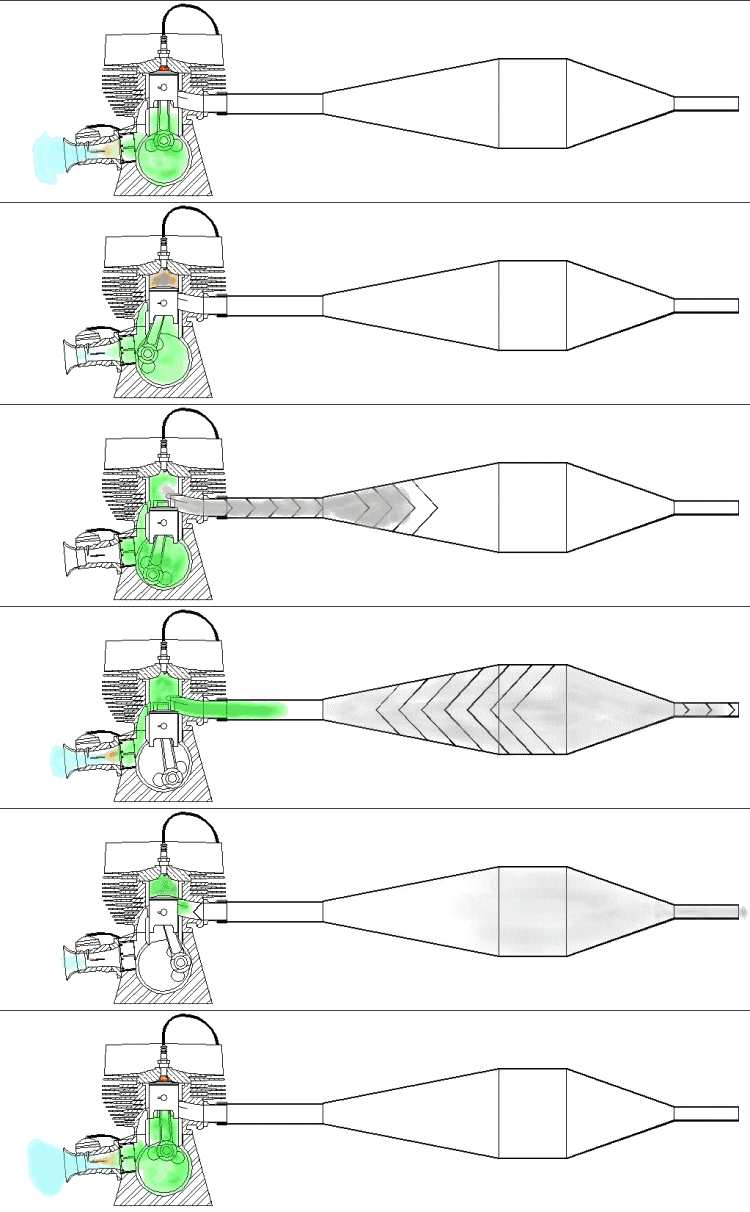
Two-stroke engines: still a viable technology?
Well-known for their simple design and ease to servicing, two-stroke engines had been almost left to die at their own, mainly because of some misconceptions about its pollutant emissions. However, if the same efforts taken by the major automobile and motorcycle industries to turn the 4-stroke the rule were employed to improve the 2-stroke combustion process all those arguments wouldn't be so true.
Some companies such as Orbital Engines and Two-Stroke Shop, both from Australia, still concentrate efforts to develop real solutions to show the 2-stroke cycle as a viable option. Orbital's engine management systems had been commercially successful either in the motorcycle industry or marine engines for jet-skis or small boats. Important companies like Bombardier, Aprilia and Bajaj adopt Orbital systems in 2-stroke engines. Two-Stroke Shop is more focused on high performance but its engines range is more old-school, with carburettors instead of Orbital's advanced direct injection, that wouldn't work with TSS's very interesting toroidal cylinder head inserts.
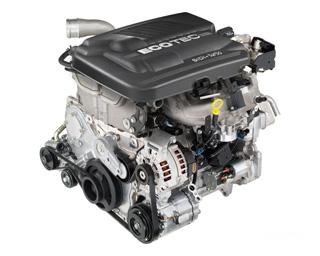
Considering the biggest trends on the motor industry nowadays, that are the downsizing and the search for a renewable energy matrix, the 2-stroke layout seems to be even easier to face them. Its own design is not just simpler, but delivers an increased power-to-weight ratio, sometimes allowing an engine with less than a half of the size of a comparable 4-stroke to get about the same performance. And since the ethanol had been shown as one of the responses to the demand for "greener" fuels, a 2-stroke would be even easier to turn into the most efficient flexfuel. SAAB had been working on a variable-compression version of the GM 2.0L Ecotec turbocharged, but since it's a 4-stroke there are some issues with the camshaft timing setup, absent in an average 2-stroke.
Another advantage to be seen more carefully by the automakers is their production cost, since less raw materials and manufacturing processes are required. Back in the 80's, Chrysler had an experimental fleet of compact vehicles fitted with 2-stroke engines, and one of the cost-cutting features was the cylinder head integrated to the block, eliminating the need for head gaskets and bolts.
Chrysler actually wasn't a strange in the 2-stroke scenario, since it had offered a great variety of stationary and marine engines with this layout. Other manufacturers such as Ford, Fiat and BMW had some R&D partnerships with Orbital from the 80's to the 90's. Ford had been one of the most involved with the 2-strokes but even with favourable results after some endurance tests in Australia and the United States there was never a regular Ford offered with such engine layout.
However, 2-stroke innovations are proposed not just in the developed world. Brazilian engineer Luciano Gama has been working with a different lube system, similar to the average 4-stroke system. I must confess I'm actually not against the currently predominant lube method because it can avoid some waste motor oil to be disposed incorrectly and then generating soil and underground water contamination risk, but since the average Joe would prefer not to burn the oil alongside the fuel it seems to be a great deal.
2-stroke engines are perceived as more pollutant because of their distinctive smoke due to the burnt oil, but either with Orbital management system or some newer, higher technology synthetic oils this problem is significantly attenuated. Another option could be the use of vegetable-based oils, such as castorbean oil widely used in kart racing.
Another advantage on the 2-stroke layout is to work on gaseous fuels such as CNG and LPG, or even hydrogen. It's not so hard to find people who complain about premature valve seats wear on 4-stroke engines converted to CNG or LPG, but since there is no valvetrain in a 2-stroke there is no problem.
As we can see, despite the media promoting more the 4-stroke, 2-stroke layout is still a great option to face the demands of the market...
Wednesday, February 16, 2011
Tricycles: a good option for commuting and light hauling
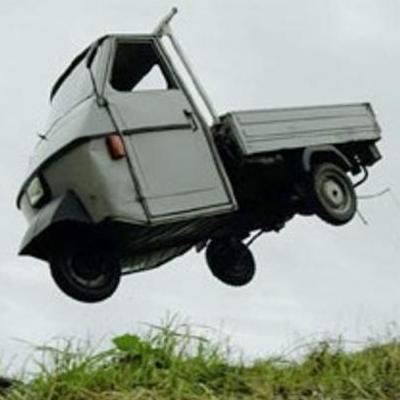
Maybe a vehicles class currently too underestimated are the tricycles. These vehicles are still useful, but with all the "car culture" promoted by the media they're shown as a simple curiosity or as a comic feature.
If someday models like the Piaggio Ape were considered an affordable option for light transport, either commercial or private, in a ruined Europe after World War II, nowadays the market has been more restricted. Almost nobody considers the possibilities of a 3-wheel vehicle as a personal commuter to face the narrow streets in some European cities with their very ancient urban scenario, or crowded Manhattan with its traffic jams. However, these curious vehicles can meet the needs of a wide range of customers, from the European teenager that is not allowed to drive a regular automobile legally (and doesn't like those "qualified quadricycles") but want more comfort and safety than an average moped to the small businessman intending to have a vehicle that arranges the capacity of an average car-based commercial vehicle with the running cost of a motorcycle.
Is not hard to find models closer in size to a Smart offering a cargo room similar to an average economy car-based van. In some cases, the ease to find engine tuning components for some 50cc tricycles is perceived by some young customers as an advantage over some "quadricycles" with their small stationary engines with limited performance parts avaliability. And it's easier to find space to accomodate a snowboard or a skate...
When there is almost no tricycles serving as taxi in the so-called "developed" world anymore, except for a few touristic places, these vehicles could actually be a good option to meet the even-more restrictive environmental laws getting enforced. Due to the lower weight, smaller engines can work properly, increasing even more the efficiency, and the pavement suffers a lesser damage than would happen with a regular-sized taxi. Also, there is one tyre less to be discarded. Another advantage to be considered by some drivers is the cockpit placed in a way that can ease the adaptation of a physical barrier to protect from eventually aggressive passengers, currently mandatory in some cities like London or New York.
For light cargo transport, by the other side, tricycles are still seen as a reasonable option, either in "developed" or "underdeveloped" countries. Even in some countries where a "tricycle culture" doesn't exist, such as Brazil, converted motorcycles have becoming more usual to see, from small towns to main cities.
At last, but not at least, tricycles can be fun to ride...
Sunday, January 30, 2011
Turning a gasser to dedicated-ethanol?
Now with all that environmental concernments, ethanol has been considered a good option by some people. I prefer biodiesel or straight vegetable oils, but there are those who prefer something that can be easier to burn in their regular gassers. But to have better results with this alternative fuel a few mods are recommended.
Ignition: since ethanol resists more to the detonation, it requires some advance and a higher-capacity ignition coil is also a good option. Ignition wiring must be in good conditions to avoid electric runaways, so those high-performance silicone-coated copper cables are strongly recommended. Spark plugs with a lower thermal grade usually have better results in ethanol-powered engines.
Compression: it's usual to have higher compressions in engines to work with ethanol. Compression ratios above 12:1 can lead to not need too much variations in the ignition advance. Either a different piston design or a lowered cylinder head can be used. Ethanol has a lesser energy density than gasoline, but higher compressions help to take it more efficiently.
Cold start ability: this is a sensible point to ethanol. In Brazil it's very common to see an auxiliary gasoline tank to be used in cold starts, while in other countries such as Sweden, France and the United States it's more usual to find the ethanol blended with regular gasoline from 15% (E85) to 30% (E70). A few years ago, Robert Bosch Gmbh. released a start system special to the so-called "flexfuel" vehicles, the FlexStart, spotting injector tips with a heater element incorporated to them, allowing the fuel to be heated until 120°C, easing the startup and also stabilizing the idle speed in the first 2 minutes after the start. The device had been used commercially only in a special edition of the Volkswagen Polo for the brazilian market in 2009, but should still be considered a serious option to a dedicated-ethanol engine.
Air intake and fuel injection: in some older dedicated-ethanol engines the intake manifold was made out of metal and could be heated by the water from the cooling system to avoid it to freeze due to the ethanol flowing alongside the intake air, but currently plastic manifolds are found almost in every car. With regular indirect injection or with a carburettor the heating is extremely helpful, but currently there are some engines featuring a direct injection setup, so it would be not so easy to have this problem. Maybe direct injection could also ease the cold starts. By the way, since ethanol has a lower energy density, its consumption is about 30 to 43% higher than gasoline, so more flow would still be required even with some mods intended to increase the efficiency with ethanol.
Cooling system: ethanol usually works better when the engine is allowed to operate in a higher temperature, for this reason a more restrictive thermostatic valve can do miracles in a water-cooled engine. For an air-cooled one it's harder to control the temperature, so idling and startups won't be so smooth, but it's not impossible to overcome this difficulty. In some older Volkswagen boxer engines from the 80s there was an automatic fold-away thermostatically-controlled airflow restrictor to leave the engine reach a temperature more suitable to operate with ethanol. However, currently only Honda motorcycles are offered with air-cooled engines able to run on ethanol and there is no airflow restrictors, mainly because of the current electronic fuel injection system that adjusts itself to operate smoothier.
Another thing that I would recommend is about valve seats lubricity requirements: it's not a bad idea to blend from 2% to 5% 2-stroke engine oil in the ethanol, even when using it in a 4-stroke engine. The oil would reduce the fatigue on valve seats, and also protect fuel lines from the more corrosive effects of the ethanol.
Ignition: since ethanol resists more to the detonation, it requires some advance and a higher-capacity ignition coil is also a good option. Ignition wiring must be in good conditions to avoid electric runaways, so those high-performance silicone-coated copper cables are strongly recommended. Spark plugs with a lower thermal grade usually have better results in ethanol-powered engines.
Compression: it's usual to have higher compressions in engines to work with ethanol. Compression ratios above 12:1 can lead to not need too much variations in the ignition advance. Either a different piston design or a lowered cylinder head can be used. Ethanol has a lesser energy density than gasoline, but higher compressions help to take it more efficiently.
Cold start ability: this is a sensible point to ethanol. In Brazil it's very common to see an auxiliary gasoline tank to be used in cold starts, while in other countries such as Sweden, France and the United States it's more usual to find the ethanol blended with regular gasoline from 15% (E85) to 30% (E70). A few years ago, Robert Bosch Gmbh. released a start system special to the so-called "flexfuel" vehicles, the FlexStart, spotting injector tips with a heater element incorporated to them, allowing the fuel to be heated until 120°C, easing the startup and also stabilizing the idle speed in the first 2 minutes after the start. The device had been used commercially only in a special edition of the Volkswagen Polo for the brazilian market in 2009, but should still be considered a serious option to a dedicated-ethanol engine.
Air intake and fuel injection: in some older dedicated-ethanol engines the intake manifold was made out of metal and could be heated by the water from the cooling system to avoid it to freeze due to the ethanol flowing alongside the intake air, but currently plastic manifolds are found almost in every car. With regular indirect injection or with a carburettor the heating is extremely helpful, but currently there are some engines featuring a direct injection setup, so it would be not so easy to have this problem. Maybe direct injection could also ease the cold starts. By the way, since ethanol has a lower energy density, its consumption is about 30 to 43% higher than gasoline, so more flow would still be required even with some mods intended to increase the efficiency with ethanol.
Cooling system: ethanol usually works better when the engine is allowed to operate in a higher temperature, for this reason a more restrictive thermostatic valve can do miracles in a water-cooled engine. For an air-cooled one it's harder to control the temperature, so idling and startups won't be so smooth, but it's not impossible to overcome this difficulty. In some older Volkswagen boxer engines from the 80s there was an automatic fold-away thermostatically-controlled airflow restrictor to leave the engine reach a temperature more suitable to operate with ethanol. However, currently only Honda motorcycles are offered with air-cooled engines able to run on ethanol and there is no airflow restrictors, mainly because of the current electronic fuel injection system that adjusts itself to operate smoothier.
Another thing that I would recommend is about valve seats lubricity requirements: it's not a bad idea to blend from 2% to 5% 2-stroke engine oil in the ethanol, even when using it in a 4-stroke engine. The oil would reduce the fatigue on valve seats, and also protect fuel lines from the more corrosive effects of the ethanol.
Thursday, January 27, 2011
why ru sucha diesel douche
i like diesel engines because of their advantages for heavy duties and for mudding, and the range of a diesel vehicle compared with a simillar with an otto-cycle engine, either a gasser, ethanol-burner or cng/lpg, and due to diesels usually last longer than other engines... i have driven some cars with cng setups and it takes a cargo space that is preserved in a diesel-powered one...
when there is no guidance the people fall, but in abundance of counselors there is victory
Thursday, January 20, 2011
Is GM ready to play the downsizing game?
Even facing some resistence from the (stereo)typical GM's most loyal customers, the downsizing is a reality that can't be denied. However, even famous for its bigger engines, as a global car manufacturing group, General Motors is ready to face competition in the newer trend in engine development.
Some american customers can still see the downsizing as an european trend, and possibly hard to overcome EPA regulations, but the use of improved smaller engines has been a way to cut greenhouse gas emissions, among other pollutants. The combustion proccess is more efficient due to the higher air flow, then less carbon monoxide is generated, for example. And an old phenomenon widely reported in early turbo setups, the turbo-lag, had its effects reduced with newer engine management systems. GM has been dominating the technology of turbochargers, and ready to face some opponents well-known for their advanced technology, such as BMW. Recently, BMW released a 2.0L twin-turbo straight-4 engine, developing 245hp and 260lb.ft, to replace its 3.0L straight-6 (258hp/230lb.ft.) in some models such as the X1. Considering the manufacturing cost, GM still has an advantage since their engine uses only one turbocharger. Even with the benefits of the smaller engine, a traditional customer would not want to pay too much more for it.
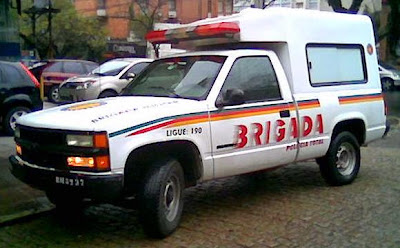
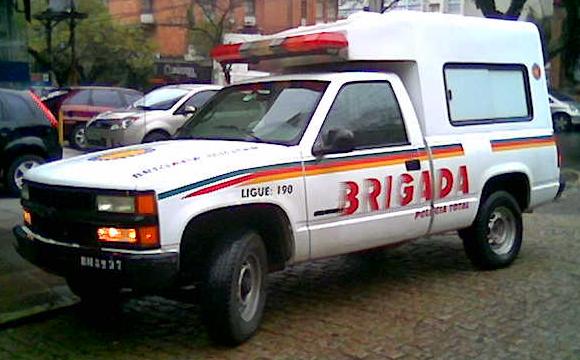
Some people possibly would never wonder something more than 50% smaller in displacement performing the same job of a 4.3L V6, often considered even "too small". For example, it's too hard to see a Chevy ambulance with a 6-cyl engine, or a police vehicle, traditionally powered by large V8's , often even restricted to the so-called "police packages".
Drawing above is only for artistic purposes, Chevrolet Astro was never used by any police department in Brazil
In other markets, most notably european countries, GM has been successful with the downsizing. Some of its models are currently offered only with turbocharged engines in Portugal, such as the Opel Insignia, currently offered in the american market as Buick Regal, featuring a 2.4L Ecotec non-turbo (182hp/172lb.ft.) not avaliable in its european counterpart and the turbocharged 2.0L in a 220hp/258lb.ft. version (this setup would already be enought to replace the 193hp/250lb.ft. 4.3L V6 in the Blazer). Surprisingly, in a segment where 4-cyl engines are perceived as "less luxury", GM is not offering the 2.8L turbocharged V6, that with its 325hp/320lb.ft. could beat the 3.6L currently used from the Chevy Camaro to the Cadillac SRX (without any V8 option in the current generation) delivering 300hp/273lb.ft., again, at higher engine speeds. Even the Vortec 4800 V8 with its 295hp/305lb.ft. could be replaced by the 2.8L without any prejudice in the performance. All of that with systems already avaliable in GM's portfolio.
So, seems like GM is ready to play the downsizing game. What about you?
Thursday, December 30, 2010
Piaggio ape into a big-rig lookalike???
Who could tell you that a tiny Piaggio Ape could be riced out to the same redneck level of a (stereo)typical american big-rig.
Yes, it's possible...
It appears to have been done by a german dude...
I must already confess that I would like to do something like this into a Piaggio Ape, but would prefer to do something resembling a Chevrolet Astro.
Despite the absence of one front wheel, it would be more proportional in terms of design...
Thursday, November 11, 2010
light diesel swaps in "yank tanks"
Is not hard to find people who like the tough look of the "yank tanks" such as Chevrolet C/K series but dislike the fuel efficiency of these rigs with their large gassers. There are even some diesel versions for these models, but they're already bigger than is often needed.
Sometimes a diesel swap is considered, and the size of the trucks allows a huge variety of engines to be fitted. Usually an american would still want a heavy-duty one such as the Cummins B-Series, specially the 3.9L 4BT/A, widely used in the step-vans replacing gassers over 5-litre.
Not to talk about Isuzu 4JB1-T and its wide range of chinese copies, now hitting the uruguayan market and widely used to move those large sedans from the 50s thru 80s and full-size pickups from almost every model year.
Friday, August 13, 2010
Subscribe to:
Posts (Atom)