



Saturday, December 11, 2021
Argentinian-made '02 Ford Ranger with factory crew-cab and artesanal wooden high-dropside flatbed
Saturday, December 04, 2021
Why could the Ford Ka Mk.1 be considered suitable to the role of a VW Beetle replacement?
Naturally some technical differences such as relying on a front-mounted transverse inline-4 engine and front-wheel drive, which became the standard for most economy-cars in the '90s along the McPherson suspension up front and a rear torsion beam, highlight much of the changes within the motor industry and the focus on "manufacturability" increasing the parts commonality with other mainstream models for better economics of scale. Unlike the Beetle which turned out to be quite unconventional according to the standards of small cars at its release, and became a category of its own, the Ka followed a quite conservative approach considering the market conditions during its development and production cycles. So, despite the obvious technical aspects and marketing circumstances which each model was subjected at their respective times, it's not totally out of question to consider the Ford Ka Mk.1 one of the possible answers to the search for an eventual Beetle replacement.
Friday, November 26, 2021
PQ24-based Fox, probably the most underappreciated Volkswagen ever
More capable of actually meeting the requirements for a small family car than the Up, maybe the Fox is even more up to the task (no pun intended again) of fulfilling the role of a Beetle replacement, despite its Euro-spec variants being only 4-seater in contrast to the 5-seater layout of the versions sold in Latin America. Its relatively long production run with fewer minor upgrades, and being based upon the same underpinnings of some mainstream European-designed model also prompts to a comparison between the Fox and the Beetle-derived Brasília, which were both Brazilian-specific designs with only a minor international availability. Relying on already-proven underpinnings, and being suitable to the fitment of up-to-date engines such as the 3-cyl flexfuel 1.0L fitted to the 2014 model-year BlueMotion version, the Fox was a smarter design than its presence more concentrated on a handful of so-called "emerging markets" in Latin America could suggest.
Monday, November 22, 2021
Brazilian Honda CG 160 modded similar to a Brat-Style
Friday, November 19, 2021
3 cars made in Brazil which actually surprised me for never having ever featured a pushrod engine
In a country like Brazil, often pointed out as a harsh environment for the most up-to-date car tech due to reckless car owners who don't really seem to care about preventive maintenance, one aspect which does often amaze me is how some so-called "people's cars" never really featured some much simpler engine designs. Sometimes there is a good reason to take benefit from the economics of scale manufacturing a very same engine which can cater both to a no-frills small car and to something else one class above, yet the higher degree of neglect entry-level models often face may justify a more austere powertrain, such as an OHV (overhead-valve) engine, a.k.a. cam-in-block or "pushrod" engine. Among so many econoboxes which had ever been available in Brazil at some point, at least 3 do surprise me enough to justify being listed as a car which could've eventually benefitted from a pushrod engine:

1 - Ford Fiesta Mk.5: this was the first generation of the Fiesta to feature only engines with either a single or double overhead cams, benefitting from the development of the Zetec-Rocam engine range which relied on a chain-driven single overhead cam and had only 2 valves per cylinder. Even though it would most likely be out of question to start manufacturing the Endura-E 1.0L and 1.3L engines locally, Ford had previously made under license from Renault some derivatives of the Cléon-Fonte engine, with the displacement ranging from 1.0L to 1.6L exactly like the Zetec-Rocam. Sure the higher performance and more rev-happy nature of the Zetec-Rocam were more in accordance to the expectations of the average Brazilian budget-conscious car buyer during the production run of the Fiesta Mk.5 and its local facelifted versions, yet its sealed timing chain can be quite bothersome to replace once the engine gets a full overhaul;2 - Brazilian Fiat Uno: unlike its European counterpart which had featured 899cc and 903cc versions of the 100-series engine, the Brazilian model resorted to a belt-driven OHC derivative of the 124-series and later to the FIRE engine. The early Fiasa engine was often plagued by timing belt ruptures and, due to its interference design, serious damage can occur if a valve still open gets hit by a piston. As a chain-driven OHV engine would be less prone to this issue, which plagued so many Fiats in Brazil until the FIRE engine already developed from scratch with an OHC valvetrain had a properly-designed belt tensioner was released locally, quite lately compared to the European market by the way, and in some neighboring countries were also offered versions of the European Fiat Uno still featuring the 100-series 903cc engine alongside its Brazilian counterparts, seems like a pushrod engine would not be so out of question regarding regional operating conditions;
3 - Fiat Palio: meant as a replacement to the Uno in Latin America, parts of Africa and Eastern Europe, having also resorted to the 124-series OHC derivative and the 128-series, also featuring the FIRE which became prevalent after the first facelift, the same harsh environmental conditions and often a precarious maintenance would justify an OHV engine. Even though the FIRE engine has often been regarded as a quite dumbproof engine, a chain-driven OHV valvetrain is often still more suitable to harsher operating conditions.
Monday, November 08, 2021
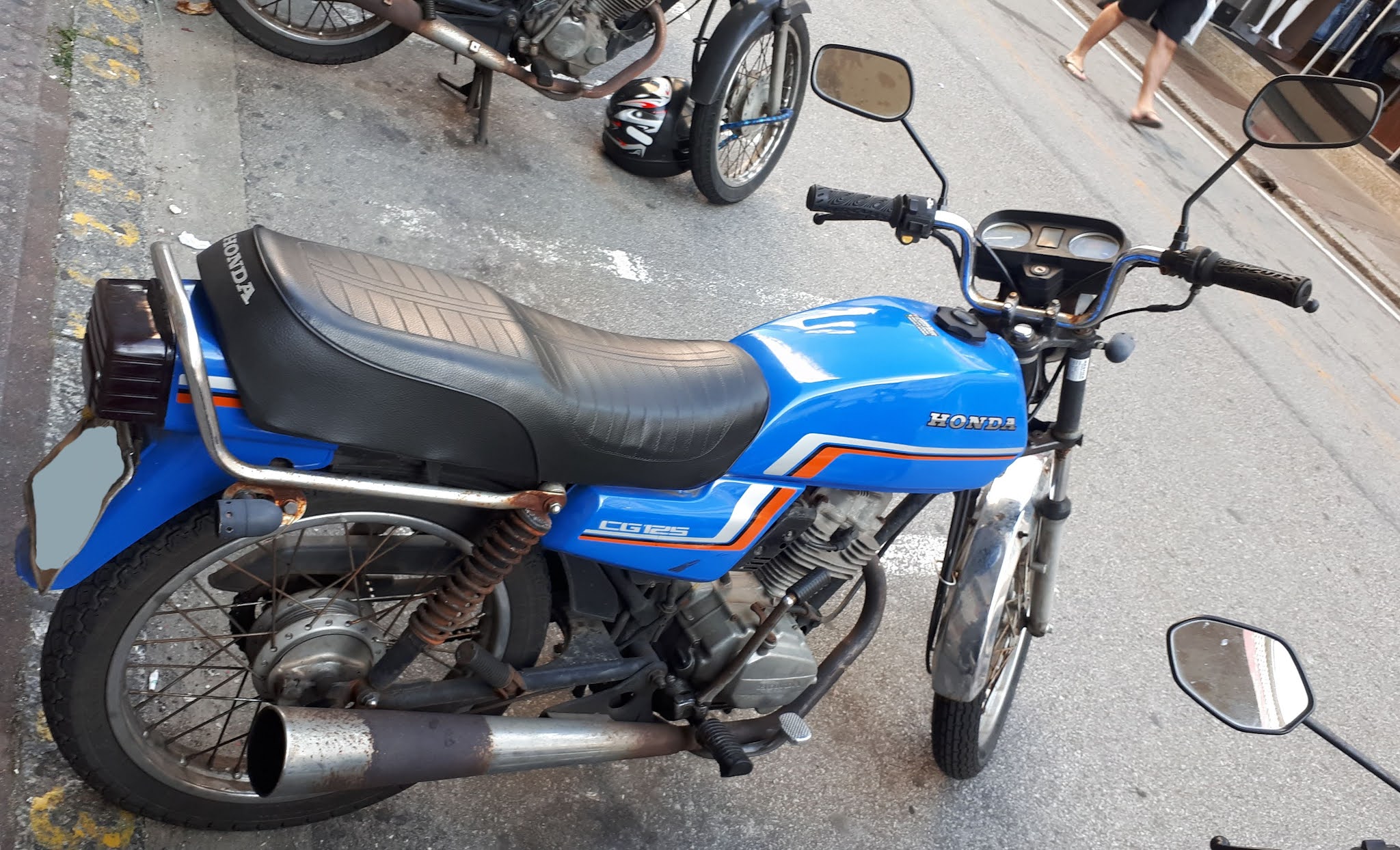
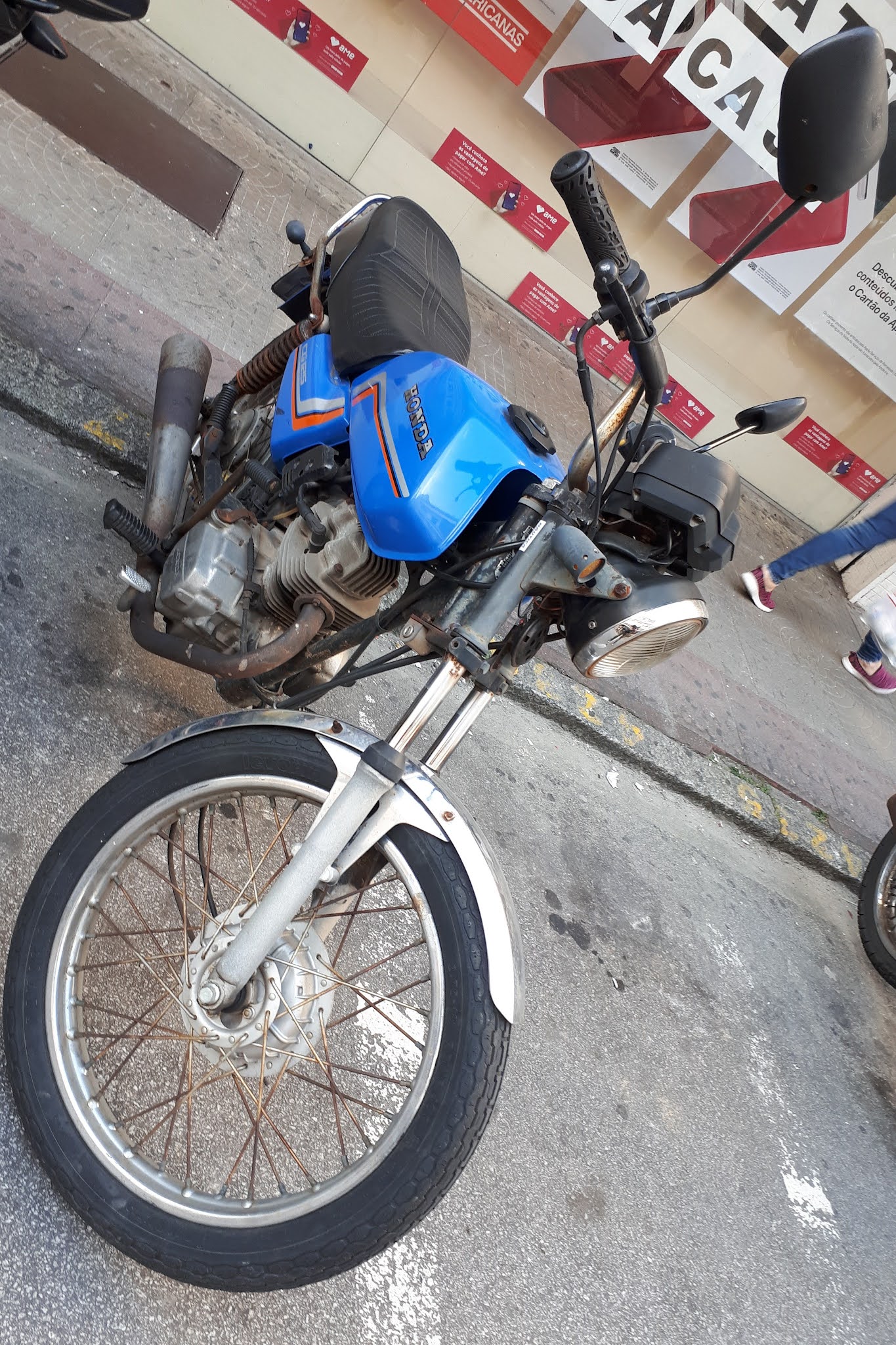
'83 Honda CG 125 on the wild
Even though it's clearly not babied, with some amount of rust clearly visible to an extention that would make it fail a roadworthiness inspection had such matter been effectively taken seriously in Brazil, the period-accurate graphics in such an utilitarian motorcycle that may eventually been subjected to harsher operating conditions is noteworthy. Seemingly quite easy to restore to a fully period-correct appearance, this '83 Honda CG 125 has its nostalgia appeal in a moment when there is a growing appreciation for its historical value, yet remaining somewhat practical instead for daily riding instead of being turned into a trailer queen to be only displayed at antique car and motorcycle events. And truth be told, its austere appearance remains quite pleasurable to see.
Monday, November 01, 2021
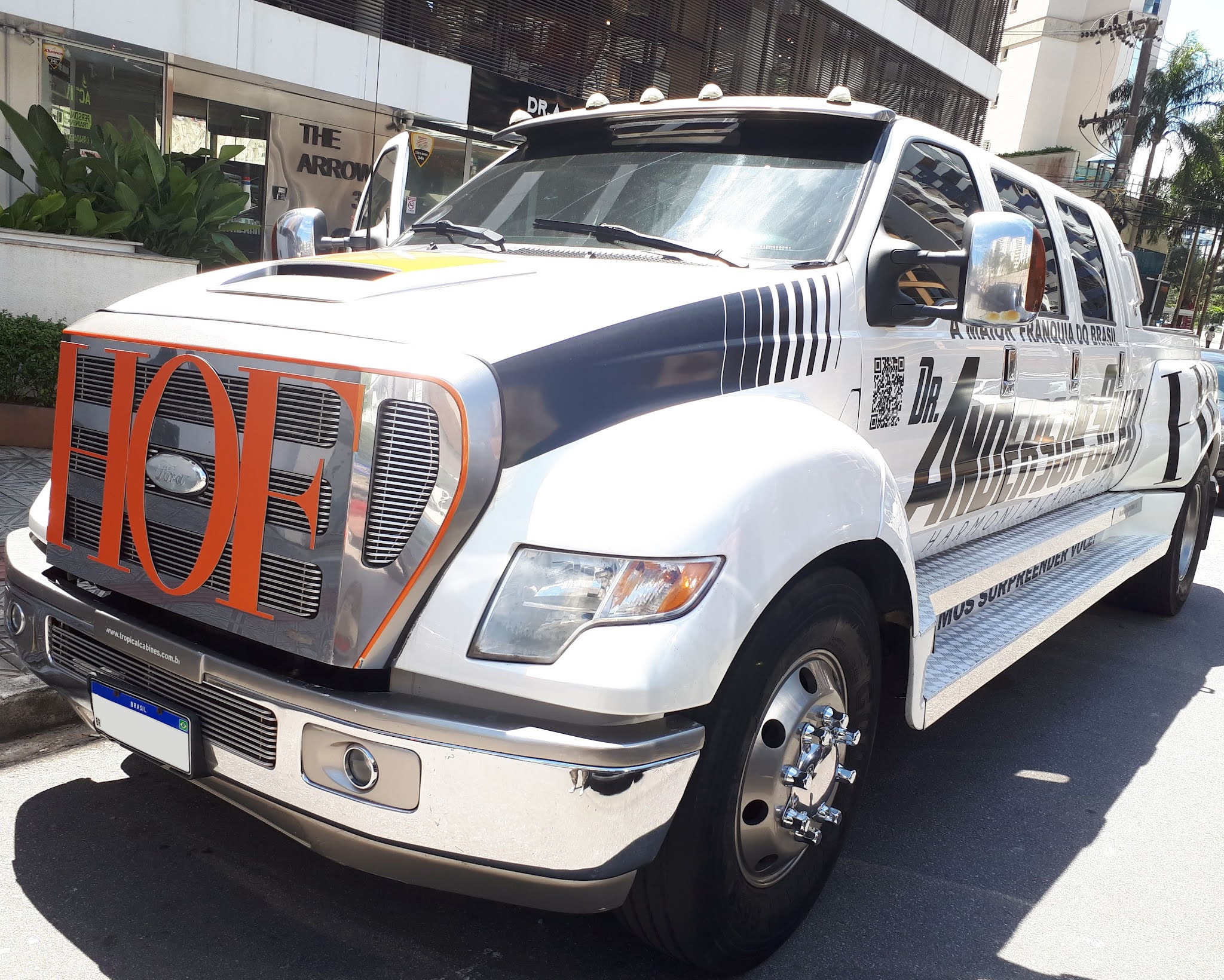
Brazilian replica of a Ford F-650 "super pick-up"
Monday, October 25, 2021
Color-matching tail lights: a reminiscence from mid-'90s
Monday, October 04, 2021
Dina D9400, a Mexican rebadged International 9400
Friday, October 01, 2021
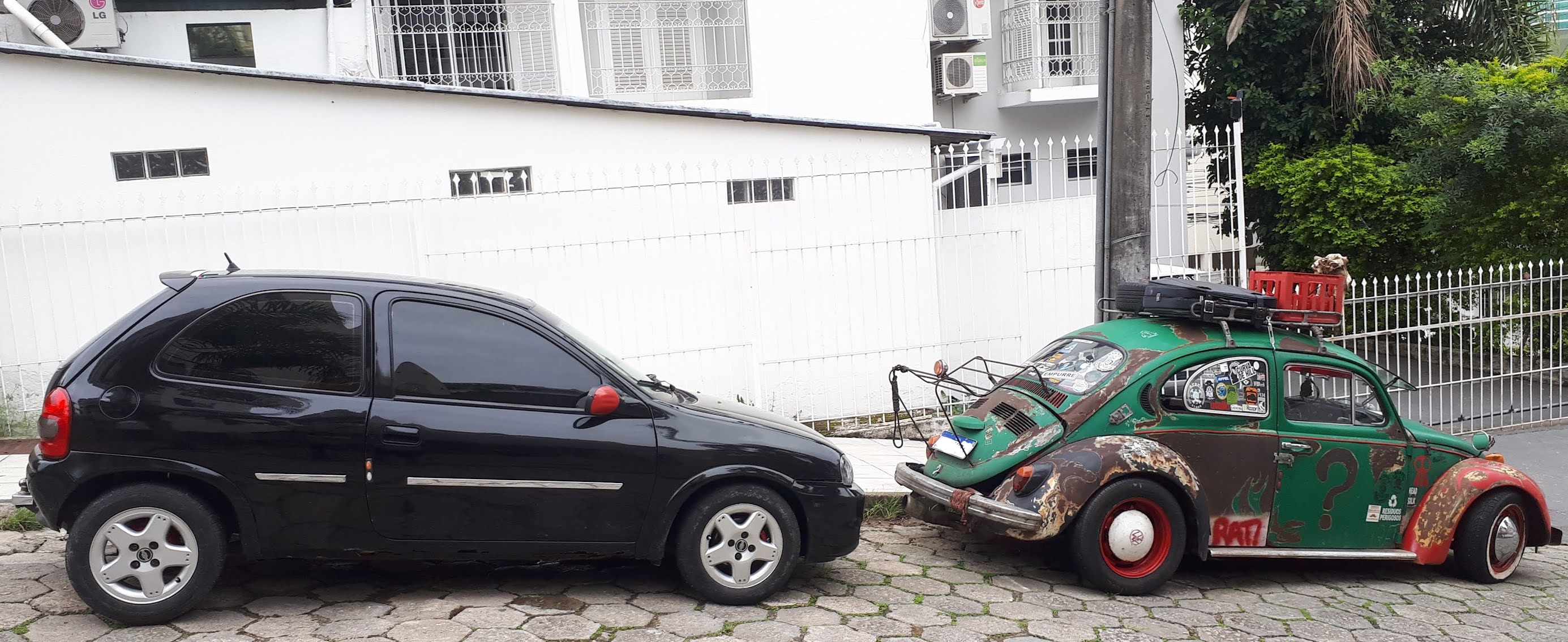
Volkswagen Beetle and Opel Corsa B: two remarkable generations of "people's car" in contrast
Another small car which had a noticeable role at the time of its release both in Brazil and Mexico, and a fierce competitor to the Beetle by the way, the Opel Corsa B was rebadged in Brazil as Chevrolet Corsa and in Mexico initially as Chevrolet Chevy. Even though its technique was quite austere in accordance to the European perspective in '93 when it arrived in Mexico initially imported from Spain and in '94 at the beginning of local production in Brazil, this model is noticeable for undeniably turning the "people's car" segment all-around, as the first real contender to the Mexican Beetle locally called "Vocho", and in Brazil its relevance as a world-class small car going as far as pioneering the electronic fuel injection for entry-level models. Eventually the Opel Corsa B may not reach a similar cult status as the Beetle, yet it had a comparable role in a time when the "people's car" concept in Brazil had already been highlighting the preferences of a more city-oriented customer base.